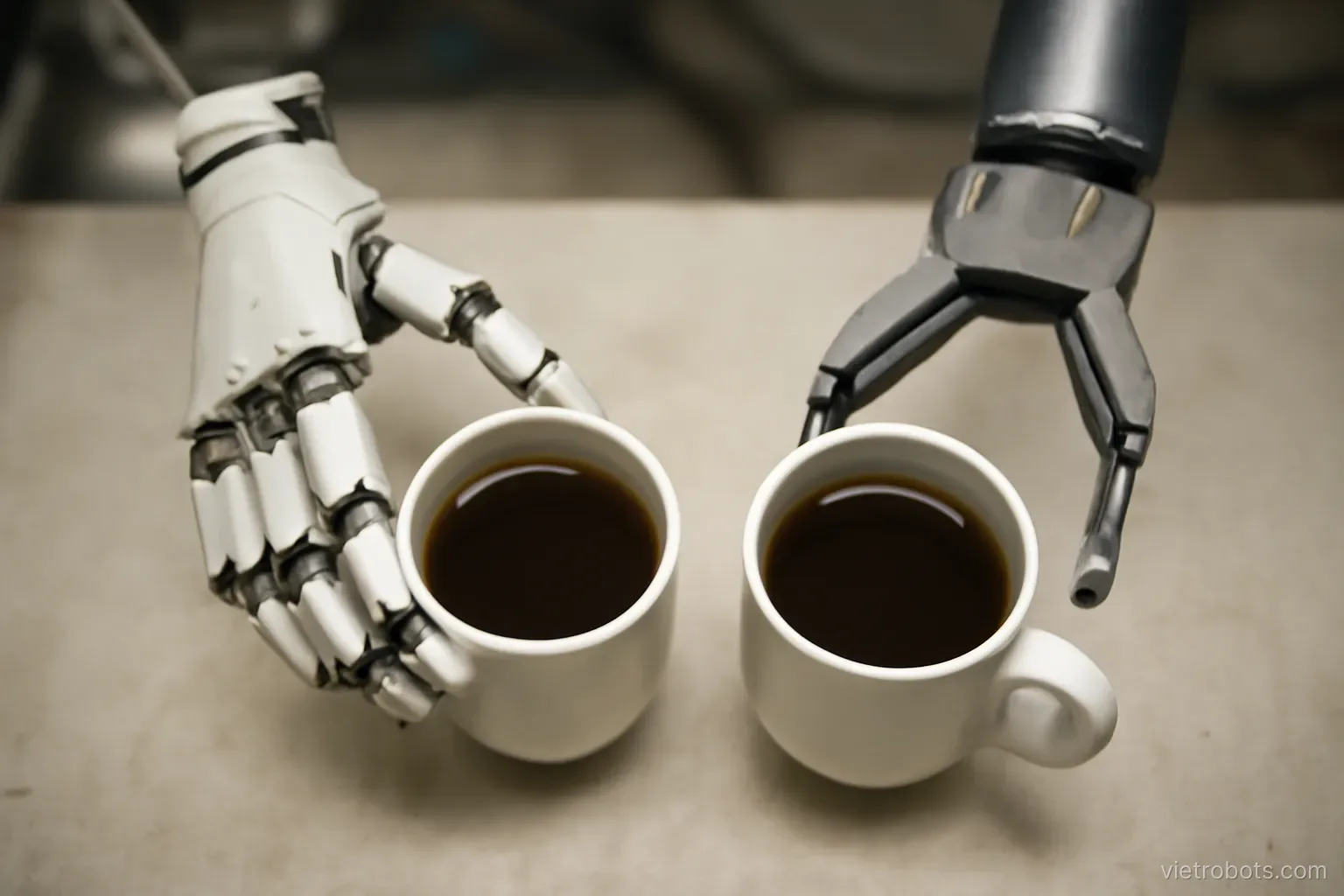
The humanoid hand is one of the most expensive, fragile, and least-used parts of a human-shaped robot. Yet every humanoid carries two of them. This article cuts through the marketing and asks a practical question: does your task actually need five fingers, or are you paying for dexterity you'll never use?
Where humanoid hands win: tasks that demand real dexterity
Picking irregular objects from a cluttered bin. A humanoid hand can rotate, cradle, and adjust grip mid-motion in ways a fixed gripper cannot. This matters when you're pulling ceramic plates or fabric rolls from an unsorted pile.
Assembly work with variable geometry. If parts arrive in slightly different orientations or sizes, five fingers can reposition and reorient without putting the object down. A two-jaw gripper would need to release and reset.
Handling delicate items that need controlled pressure. Humanoid hands can modulate grip force across multiple fingers. A parallel gripper applies symmetrical pressure—fine for a cardboard box, dangerous for an egg or a phone screen.
Working in spaces designed for human hands. Some environments—existing factory stations, retail shelves, kitchen appliances—have handles, knobs, and gaps sized for human fingers. A humanoid hand fits. A gripper needs modification or replacement.
Manipulation that requires tool use. If a robot needs to hold a screwdriver, wrench, or paint brush and adjust its angle mid-task, a humanoid hand is faster. A gripper would need tool changers and repositioning.
Tasks where hand presence signals competence. In human-facing roles—demonstration, training, public-facing assembly—a hand that looks human reduces unease and builds confidence in the technology. This is psychological, not functional, but it matters for adoption.
Multi-step tasks where the hand stays on the object. When a robot must hold, rotate, adjust, and release without intermediate drops, five fingers working in coordination save cycle time compared to gripper swaps.
Reaching into confined spaces with precision. A humanoid hand can squeeze between obstacles and flex its fingers around corners. A rigid gripper cannot.
Grasping objects with no predefined grasp points. When you cannot bolt a gripper-friendly feature onto every part, a hand that finds grip anywhere is valuable.
Tasks that combine multiple object types in one cycle. If a robot must pick a box, then a bottle, then a cable, a humanoid hand adapts. A gripper would need three tool changes or three separate robots.
Where grippers dominate: the work humanoid hands almost never do
High-speed bin picking at scale. Industrial bin-picking systems use vacuum cups or parallel grippers because they are fast, reliable, and standardized. A humanoid hand is slower and requires more processing to plan each grasp.
Lifting heavy loads repeatedly. A gripper rated for 100 kg will grip 100 kg all day. A humanoid hand spreading load across five fingers tires servos and degrades joint seals. Simple grippers outlast complex hands by years.
Palletizing and stacking identical items. When every object is the same size and weight, a gripper does the job in fewer milliseconds and with zero variation. Speed and consistency beat flexibility.
Handling rough, abrasive, or dirty materials. Grippers have fewer moving parts and simpler seals. Sand, metal shavings, and chemical residue will jam a humanoid hand's finger joints far sooner than they will damage a gripper's jaw.
Transferring objects between fixed stations. If a robot only ever picks from point A and places at point B, and the geometry is known, a single-purpose gripper is cheaper, faster, and more reliable than a general-purpose hand.
Vacuum or magnetic gripping. Some materials—sheet metal, glass, sealed bags—grip better with suction or magnetism than with mechanical fingers. A gripper specializes in these; a humanoid hand cannot.
Tasks where the gripper never changes orientation. If a robot only ever grips from above and releases straight down, a vertical parallel gripper is simpler and more robust than a hand that can rotate and flex.
Wet or humid environments. Seawater, steam, and washdown spray corrode humanoid hand servos and seals. Industrial grippers with sealed, stainless designs survive these conditions for years.
Work under continuous moderate load. Holding 20 kg for eight hours taxes humanoid hand joints. A gripper holding the same load experiences no wear.
Tasks where speed is the only metric. A gripper picks and places in 2–3 seconds. A humanoid hand needs vision processing, grasp planning, and motion smoothing. If cycle time is everything, the gripper wins.
Cost and reliability: why humanoid hands are expensive to own
Purchase price is only the start. A humanoid hand costs $15,000–$40,000 per unit. A parallel gripper costs $500–$3,000. But the hand's true cost emerges in maintenance.
Finger joints fail under normal use. Servo motors in humanoid fingers wear out in 12–24 months of daily operation. Replacement is $2,000–$5,000 per finger. A gripper jaw replacement is $200–$500.
Grasp planning slows down production. Every pick with a humanoid hand requires computer vision and grasp algorithm processing. A gripper with a fixed mount needs only position coordinates. The processing overhead adds 500–2,000 milliseconds per cycle.
Dexterity creates more failure modes. More joints mean more points of failure. A humanoid hand has 20+ moving parts per hand. A parallel gripper has 3–5. Statistically, hands break more often.
Repairs take longer and cost more. Replacing a gripper takes 15 minutes and $300. Replacing a humanoid hand servo takes 2–4 hours and $3,000. Downtime compounds the cost.
Training technicians is harder and slower. Any technician can service a gripper. Humanoid hand repair requires training specific to that hand model. Finding a qualified technician in Vietnam may mean shipping the hand overseas.
Spare parts inventory is larger. You need backup grippers and replacement jaws. For humanoid hands, you need spare servos, wiring, control boards, and fingers. Inventory costs rise with complexity.
Software updates are mandatory and risky. Humanoid hand firmware updates can improve performance but may also introduce bugs or compatibility issues. Gripper firmware rarely changes.
Dexterity is unused most of the time. If your task uses only 30% of a hand's capability, you are paying 100% of its cost and bearing 100% of its maintenance burden for 30% of its value.
Total cost of ownership over five years favors simple tools. A $1,000 gripper that needs $200 in repairs annually costs $2,000 over five years. A $30,000 humanoid hand needing $5,000 in annual repairs costs $55,000 over five years—27 times more.
Hybrid approach: when to combine humanoid arms with specialized grippers
Use the humanoid arm; change the gripper for each task. The arm's dexterity—reaching, positioning, approach angle—is valuable. The hand's flexibility is not. Swap grippers for different materials: parallel jaw for boxes, vacuum for glass, magnetic for metal, two-finger for soft goods.
Mount quick-change couplers on the wrist. A robot can swap grippers in 3–5 seconds with a mechanical coupler. This costs $500–$2,000 and multiplies the value of a single arm across five different tasks.
Keep the humanoid hand for one specific task; use grippers for the rest. If you have one assembly step that genuinely needs five fingers—say, inserting a cable into a tight connector—use the hand for that and gripper for everything else. This gives you the best of both without overpaying for unused dexterity.
Use humanoid hands only for low-volume, high-value tasks. If a task runs 100 cycles per day, the humanoid hand's slower speed and higher failure rate become expensive. If it runs 5 cycles per day, the hand's flexibility is worth the cost.
Automate the simple tasks with grippers first. Start with gripper-based automation for your highest-volume, most repetitive work. Use humanoid hands only for the tasks grippers cannot handle—the 10–15% of your workload that truly needs flexibility.
Pair a humanoid with multiple gripper stations. One robot with a quick-change wrist can move between stations, each with a different gripper pre-mounted. The arm does the motion; the gripper does the grip. Lower cost, higher reliability than a humanoid hand.
Use hand simulation before buying. Test your task with a humanoid in simulation first. If the task works equally well with a three-finger gripper or parallel jaw in simulation, it will work better with the gripper in production.
Reserve humanoid hands for research and development. If you are exploring new tasks or processes, a humanoid hand gives you flexibility to test ideas quickly. Once the task is proven, switch to a gripper for production.
Document what your humanoid hand actually does. Track every grasp type your hand performs over one month. If you use fewer than five distinct grasp patterns, a custom gripper could replace it and save money.
Budget for hand maintenance separately. If you buy a humanoid, set aside 15–20% of its purchase price annually for hand repairs. This is realistic, not pessimistic. Plan for it upfront or you will be surprised by costs.
Practical decision framework: hand or gripper?
Ask: Is the task cycle time less than 30 seconds? If yes, a humanoid hand's slower grasp planning becomes a bottleneck. A gripper is faster. If no, the hand's flexibility may be worth the time cost.
Ask: Do objects vary in size by more than 50%? If yes, one gripper will not work; you need either a hand or multiple grippers. Calculate which costs less: three grippers with quick-change ($6,000) or one humanoid hand ($30,000)?
Ask: Can you modify the object to be gripper-friendly? If you can add a handle, recess, or flat surface designed for a gripper, do it. This is cheaper than buying a humanoid hand to handle unmodified geometry.
Ask: Is the task already done by humans in this facility? If yes, watch the human. Count how many distinct hand positions they use. If it is fewer than three, a gripper can replace the hand. If it is more than five, a humanoid hand may help.
Ask: How many times per day does the gripper need to change? If more than ten times per day, manual or semi-automated gripper changes become expensive. A humanoid hand reduces the number of changes. If fewer than three times per day, quick-change grippers are simpler and cheaper.
Ask: Is downtime tolerable? If a robot failure stops the entire production line, you need maximum reliability—use a gripper. If a robot failure is an inconvenience but not a disaster, a humanoid hand's higher maintenance burden is acceptable.
Ask: What is the failure rate of similar grippers in your industry? Talk to other factories in Vietnam doing similar work. If grippers fail once per year, expect humanoid hands to fail three to five times per year. Can your maintenance budget absorb that?
Ask: Do you have technicians who can repair humanoid hands? If no, add three to six months to your project timeline for training or finding external support. If yes, the humanoid hand becomes viable sooner.
Ask: Will this task change in the next three years? If yes, a humanoid hand's flexibility justifies its cost—you can reprogram it for new tasks. If no, a purpose-built gripper is a better long-term investment.
Ask: What is the total cost of ownership over five years? Build a spreadsheet: purchase price, annual maintenance, downtime labor, parts inventory, training. If the gripper total is less than half the humanoid hand total, use the gripper unless the task is impossible without a hand.
Frequently asked questions
Can a humanoid hand do everything a gripper can do?
Yes, but slower and less reliably. A humanoid hand can grip boxes, hold weight, and release objects. But it does these tasks in 3–5 seconds where a gripper takes 1–2 seconds, and it will need repairs twice as often. A hand is a generalist; a gripper is a specialist. Use the hand only when the task requires true dexterity.
How long does a humanoid hand last before servos fail?
In continuous operation, expect servo failures in the first 12–24 months. This depends on cycle count, load, and environmental conditions. A gripper with no electronics will outlast a humanoid hand by 5–10 years under the same conditions. Plan for annual servo replacement costs of $3,000–$8,000 per hand if you use it daily.
What is the cheapest way to get humanoid-like dexterity?
Use a humanoid arm with a quick-change wrist coupler and three to five specialized grippers. This costs $25,000–$35,000 instead of $40,000–$60,000 for a humanoid with two hands, and it is more reliable. You keep the arm's reach and positioning ability while using cheap, reliable grippers for the actual grasping.
Should we buy a humanoid hand for a task we are unsure about?
No. Test the task first with gripper simulation or with a loaned robot. If the task works with a gripper, it will be cheaper and more reliable in production. Buy a humanoid hand only after you have proven that the task truly requires five-finger dexterity and that no gripper can do the job. This saves money and avoids technology you do not need.
More in Robots in Vietnamese business and Cost and selection.