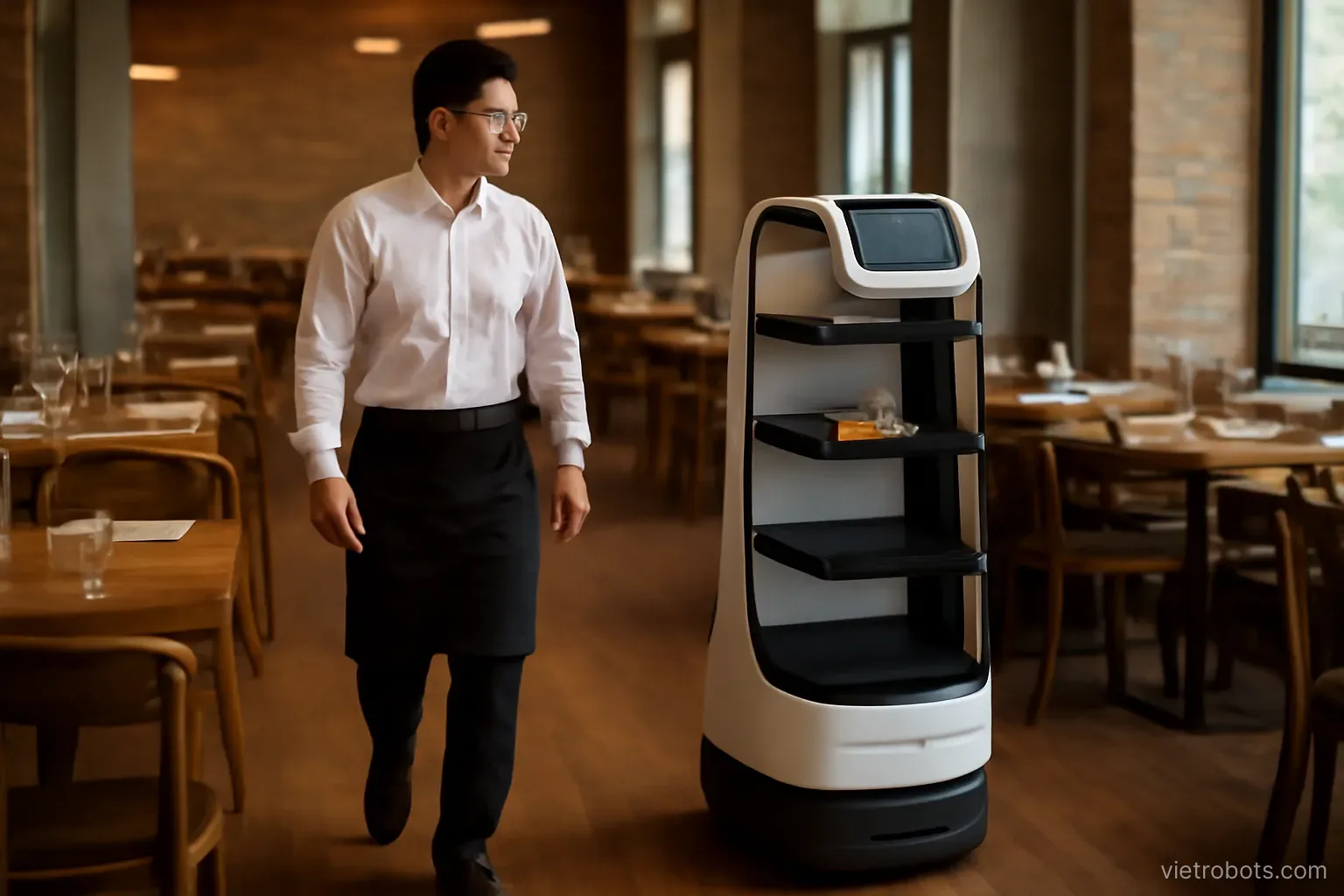
The discussion about robots and employment concentrates on what disappears. The work created is less visible and it is not small — every deployed robot generates ongoing human labour, and someone is paid to do it.
The roles around a single deployment
Trace one robot in one business and count the work.
Someone specified it. Worked out what it should do, what it should not attempt, how it fits the operation.
Someone installed and mapped it. A day or more on site.
Someone wrote the content. Often the largest single piece of work, and frequently underestimated.
Someone integrated it with the booking or point-of-sale system.
Someone trained the staff.
Someone maintains it ongoing — content updates, log review, fault handling. Small per robot and it accumulates.
Someone services it. Parts, repairs, replacements.
Seven distinct pieces of work, most requiring skill, and none of which existed before the robot did.
Content operations
The least discussed and possibly the largest category.
What it involves. Writing what the robot knows, keeping it current, restructuring it when answers come out wrong, reviewing what people asked and adding what was missing.
Why it never finishes. Businesses change. Prices, hours, staff, procedures, offerings. Each change is a content change, and a robot with stale content is worse than no robot because it gives confident wrong answers.
What it requires. Clear writing, attention to detail, and understanding how a retrieval system finds information. Not engineering.
Why it is underfunded. It is invisible when done well. Nobody notices content that is correct.
Where it sits. Sometimes with the supplier, sometimes with the business, and disastrously often with nobody — which is the most common reason deployments decay.
For anyone looking at this field, this is the most accessible entry point with the clearest demand and the least competition.
Field service and operations
What it involves. Attending sites when robots stop, diagnosing faults, replacing parts, re-mapping after a layout change, handling software updates.
Why it grows with the installed base. Every robot deployed adds to the maintenance load permanently. A supplier with a hundred robots in the field needs people whether or not they sell another.
What it requires. Practical troubleshooting, willingness to travel, patience with customers who are frustrated. Technical training helps and a degree is not usually necessary.
Why it is a good entry route. You see many deployments across many settings, which builds an understanding of what works that no amount of reading provides. People who move into application design or sales usually come through here.
What it is short of. People who can explain a fault to a non-technical customer without either patronising them or leaving them confused. This is what distinguishes a valued field engineer from an adequate one.
The specialist roles
Language and speech work. Improving Vietnamese recognition, handling regional accents, tuning response wording and pronunciation. Sits between linguistics and engineering, and manufacturers do not do it to the standard local markets require.
Integration development. Connecting robots to the systems businesses already run. Ordinary software work with a robot as one endpoint, and a comfortable transition for existing developers.
Application design. Deciding what a robot should do in a particular kind of business. Requires understanding both the technology and the operation, which is a rarer combination than either alone.
Safety and compliance. Assessing sites, checking clearances, handling requirements for radio equipment and workplace safety.
Training design. Building the material that teaches staff to work with the system, in Vietnamese, for people who will not read a manual.
Honest sales. Understanding the technology well enough to say what it will not do. Undersupplied everywhere and it is what separates suppliers whose customers stay.
The honest accounting
Because the created-jobs argument is sometimes overstated.
The created jobs are fewer than the displaced tasks. That is the point of automation. A robot handling four hundred questions a day does not generate four hundred questions' worth of human work maintaining it.
They are different jobs, in different places, needing different skills. The person whose task was absorbed is not automatically the person who gets the new one. This is the real difficulty and it is not solved by pointing out that new roles exist.
They are more skilled and better paid on average. Which is good for those who reach them and no consolation to those who do not.
They are more concentrated. Suppliers and integrators cluster in cities.
What this means practically. The created work is real and worth knowing about, particularly for anyone choosing a direction. It is not an argument that displacement does not matter — both things are true at once, and treating either as the whole picture produces bad reasoning about the field.
Frequently asked questions
How much human work does one deployed robot generate?
Seven distinct pieces: specifying, installing and mapping, writing content, integrating with existing systems, training staff, ongoing maintenance and content updates, and physical servicing.
Why is content operations the largest category?
Because it never finishes. Businesses change prices, hours, staff and procedures constantly, and each change is a content change. A robot with stale content gives confident wrong answers.
Why is field service a good entry route?
You see many deployments across many settings, which builds an understanding of what works that reading cannot provide. People who move into application design or sales usually come through it.
Do created jobs offset displaced tasks?
Not in number — that is the point of automation. They are also different jobs in different places needing different skills, so the person whose task was absorbed is not automatically the one who gets the new role.
More in Myths and questions and Voice and language.