Everyone wants a date. The honest position is that this field has an unusually poor forecasting record in both directions, and understanding why is more useful than any particular prediction.
Why predictions here fail
A consistent pattern with identifiable causes.
Demonstrations mislead about difficulty. A robot doing something once in a prepared setting looks close to a product. The distance from that to reliable operation in ordinary conditions is routinely underestimated by years.
The last portion of reliability costs the most. Getting from eighty per cent success to ninety-five is harder than getting to eighty, and from ninety-five to the level a business will tolerate is harder still.
Deployment is slower than capability. Even where a technology works, adoption is limited by cost, training, integration and organisational willingness. These move at the speed of institutions rather than of research.
Forecasters have incentives. Companies raising money, researchers seeking funding and publications seeking attention all benefit from shorter timelines.
And the opposite error occurs too. Language handling improved faster than nearly anyone predicted. Confident dismissal has been wrong as often as confident enthusiasm.
What is reliably true now
Starting from the observable, since it anchors everything else.
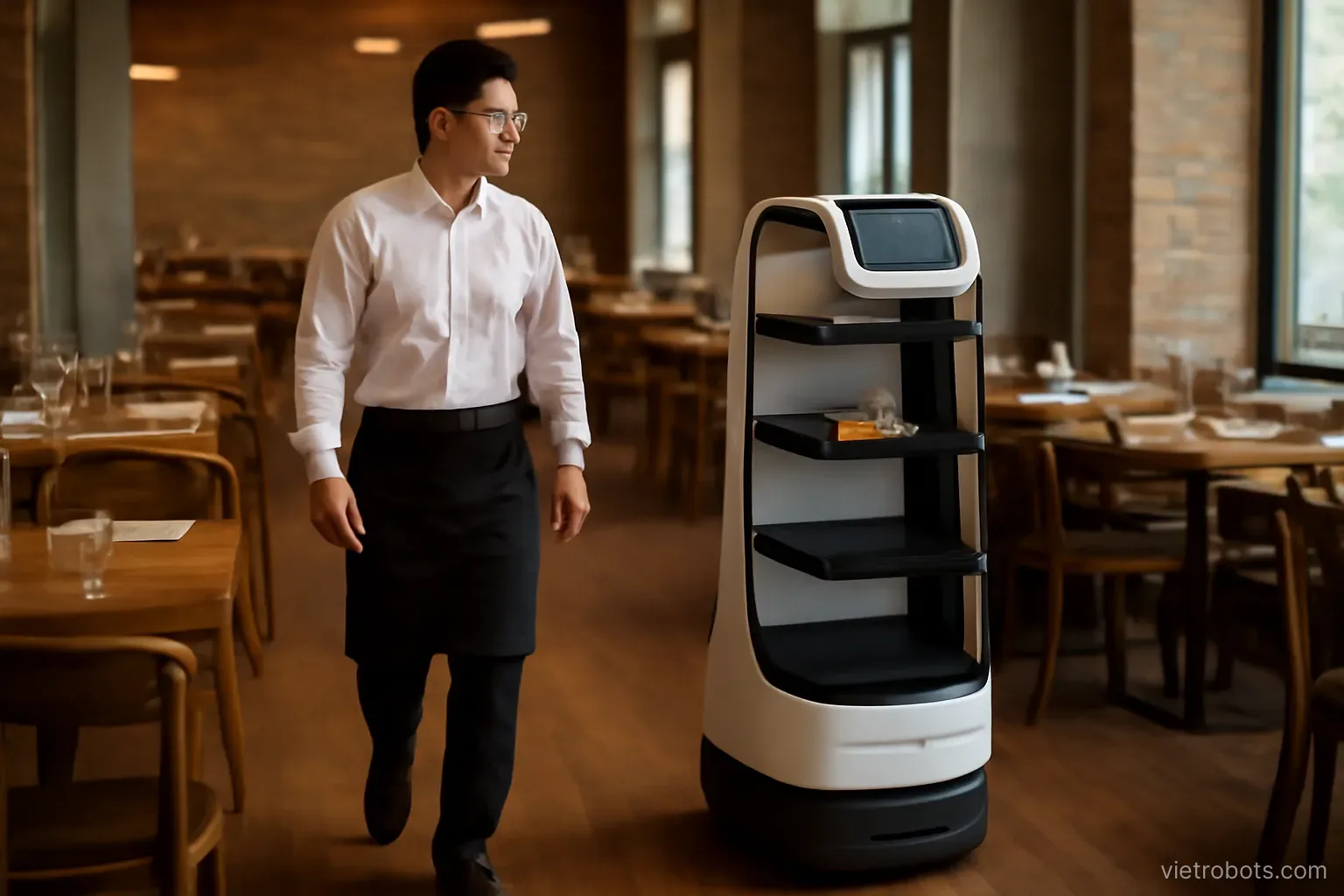
Robots that talk, move on mapped routes and carry things work reliably today. Deployed in ordinary businesses, running for years. Not speculative.
Robots that clean open floors work. Domestically and commercially.
Robots that repeat precise motions in fixed settings work. Have done for decades.
Robots that handle unfamiliar objects in cluttered spaces do not work reliably. Impressive research demonstrations, no dependable product.
Robots that operate in homes beyond floor cleaning do not exist as products.
General-purpose humanoids doing varied useful work are in early trials. Real progress, real investment, and not yet a product anyone can buy and rely on.
This division — reliable, unreliable, absent — is more useful than any date, and it changes slowly enough to remain accurate for a while.
How diffusion actually works
The pattern is well established across technologies and it applies here.
Capability arrives before affordability. The first working version is expensive, and price falls over years as volume builds.
Affordability arrives before adoption. Businesses do not buy simply because something is affordable. They buy when the case is proven by someone else and the risk is understood.
Adoption arrives before impact. Even after purchase, effects take time as processes adjust around the tool.
Each stage is measured in years. Which is why economy-wide effects lag visible capability by a long interval, and why the experience is of slow change rather than sudden change.
The practical implication. Something demonstrated impressively today is unlikely to affect ordinary workplaces for years. That is time to adjust — which is only useful to people who use it.
A reasonable expectation
Stated as direction rather than as dates, because directions are more defensible.
Service robots become ordinary infrastructure. Present in restaurants, hotels, hospitals and shops to the point of not being remarked on. This is already underway.
Conversational capability keeps improving and gets cheaper. The most reliable trend in the field.
Manipulation improves gradually and remains the bottleneck. Progress is real and the gap between demonstration and dependable product stays wide.
Humanoids find narrow footholds first. Specific tasks in specific settings, not general capability. If they arrive broadly, it will be through accumulated narrow uses rather than a single breakthrough.
The operational layer grows faster than the hardware layer. Content, integration, maintenance. This is where the work and the money increasingly sit.
Nothing changes overnight. The most confident statement available, and the one most consistently borne out.
Planning under uncertainty
What to do when the timeline is genuinely unknown.
Prefer decisions that hold under several scenarios. Learning to work with AI tools is useful whether adoption is fast or slow. Betting a career on a specific technology arriving by a specific year is not.
Watch deployments rather than announcements. The number of machines actually working somewhere is the honest indicator, and it moves slowly enough to track.
For a business: buy for a problem you have now. Not for a capability expected later. Roadmaps slip and the machine you own is the one that shipped.
For an individual: build things that stay valuable. Judgement, domain knowledge, dexterity in varied conditions, the ability to explain and to persuade.
Revisit periodically. Once or twice a year, look at what is now reliably deployed that was not before. That single observation tracks the field better than following announcements continuously.
And hold conclusions loosely. The people who were most wrong in this field, in both directions, were the ones most certain.
Frequently asked questions
Why are predictions in robotics so often wrong?
Demonstrations mislead about difficulty, the last portion of reliability costs the most, deployment moves at institutional rather than research speed, and forecasters have incentives toward shorter timelines.
What works reliably today?
Robots that talk, move on mapped routes, carry things and clean open floors, plus industrial arms repeating precise motions. Handling unfamiliar objects in cluttered spaces does not work reliably.
Why do economy-wide effects lag visible capability?
Capability arrives before affordability, affordability before adoption, and adoption before impact — each stage measured in years. That is why the experience is of slow rather than sudden change.
How should you plan when the timeline is unknown?
Prefer decisions that hold under several scenarios, watch deployment counts rather than announcements, buy for a problem you have now, and build capabilities that stay valuable regardless of pace.
More in AI robots for real work and Cost and selection.