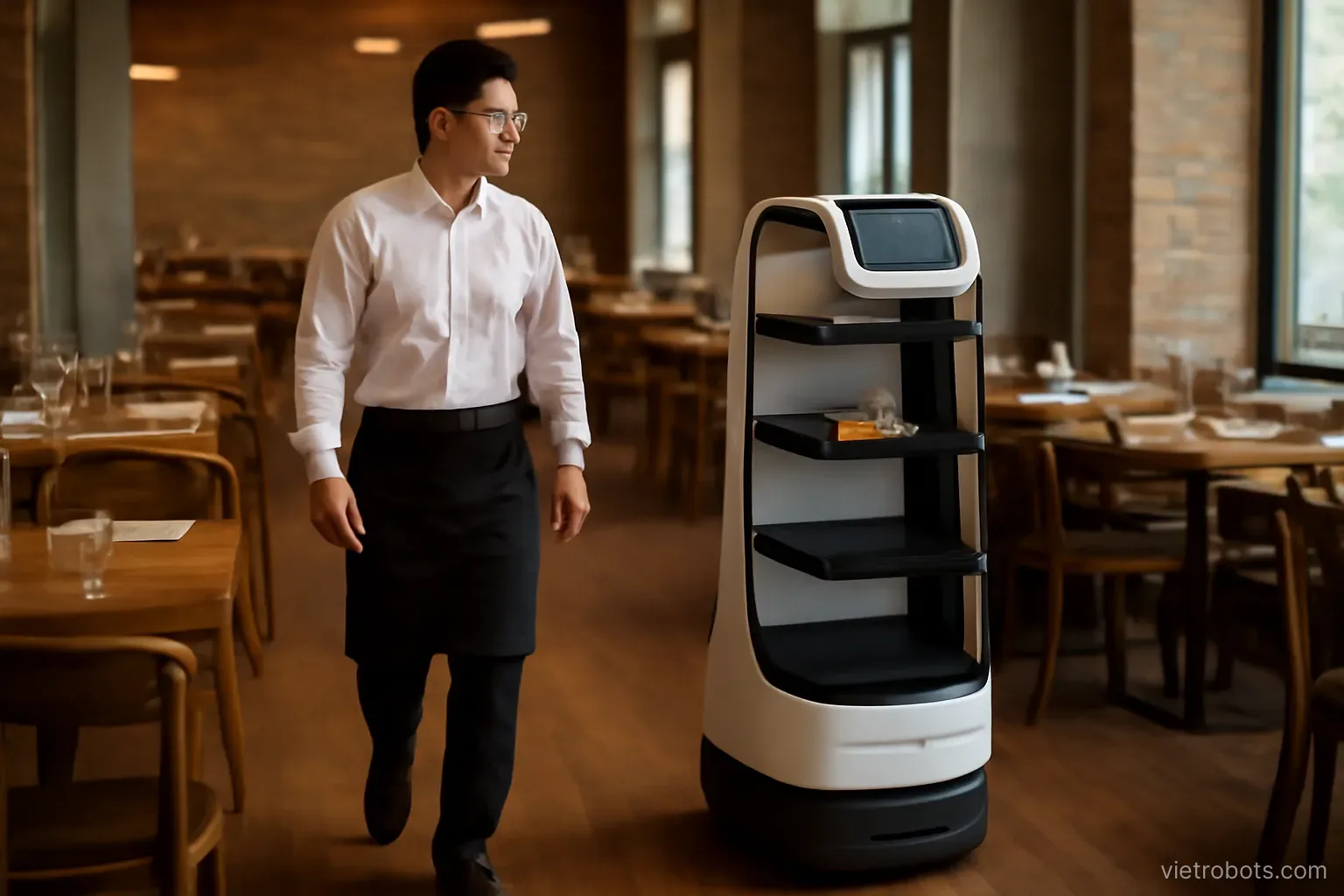
Most writing about robots and work is about whether jobs disappear. Rather less is about what the arrangement is actually like for the people working next to one, which is the part most people will experience.
What changes in the first weeks
Customers pay attention to the robot and not to you. Novel for a while, then it fades, and both phases are worth expecting.
You are asked about it constantly. Customers want to know what it is, what it costs, whether it will replace you. Having a short answer ready helps.
You spend time unblocking it. Early on, more than expected. Chairs in the way, doors closed, a bag left in the corridor. This reduces once the space adapts.
Some of your routine questions stop coming. Which is quieter than anticipated and takes adjustment.
The questions that do reach you are harder. The straightforward ones were absorbed, so what remains is the complicated end. This is genuinely more demanding work.
You develop an opinion about it quickly. Usually within two weeks, and usually decided by whether it took a task you disliked or one you valued.
The division that works
Where deployments settle successfully, the split tends to look similar.
The robot takes: repeated information, fixed-route carrying, first contact at busy moments, and out-of-hours coverage.
People take: anything unusual, anything where someone is unhappy, anything requiring a decision, and anything physical involving unfamiliar objects.
The handover point matters more than either side. How the robot passes a situation to a person determines whether the arrangement feels smooth or broken. A robot that says it cannot help and stops is worse than no robot. One that says it will fetch someone, and does, works.
Staff need to be able to intervene. Taking over a conversation, stopping the robot, redirecting it. Where staff have no control, resistance is reliable.
Do not let the robot be the only route. A customer who wants a person should reach one without argument. Businesses that force the robot as a gatekeeper generate complaints out of proportion to any saving.
New responsibilities that appear
Real work, often unassigned, which is where deployments fail.
Noticing when content is wrong. Staff hear the robot answering and are the first to know it is giving an outdated price. Reporting that needs to be somebody's expected task, with an easy route.
Basic recovery. Clearing an obstruction, restarting, returning it to its charging point.
Charging discipline. Ensuring it is on charge at the end of a shift.
Cleaning it. Sensors covered in dust or fingerprints degrade performance, and nobody thinks of this until something stops working.
Explaining it to customers. A small but constant demand.
These should be named in someone's role. Where they are everyone's responsibility they are nobody's, and the robot degrades quietly until it is not used. Fifteen minutes a day, explicitly allocated, is usually enough.
Common friction and how to reduce it
It gets in the way at peak times. The most frequent complaint. The fix is scheduling — restrict it during the busiest period, or route it away from the congested area.
It answers wrongly and staff are left correcting it. Corrosive to confidence. Fix the content quickly when reported, and make sure staff see that reporting produced a change.
Customers treat it as a toy. Photographs, deliberate obstruction, children climbing. Reduced by placement and by staff being comfortable asking people not to.
It fails and nobody knows who to call. Post the number where staff can see it.
Management measures the robot and not the work. Where interaction counts become a target, staff push customers toward it regardless of whether it helps, and service gets worse.
The underlying rule: friction almost always traces to a decision made without asking the people who work next to it. Asking them first prevents most of it.
For managers introducing one
Short and specific.
Tell staff before it arrives, not on the day.
Say plainly what it means for jobs. If nobody is being replaced, say so in those words. Ambiguity is read as bad news.
Give it the task staff least enjoy. The fastest route to acceptance there is.
Ask staff what customers actually ask before writing the content. They know and management usually does not.
Name the person responsible and give them the time. Not an addition to a full workload.
Let staff switch it off. The single most effective measure for reducing resistance, and the one managers are most reluctant to allow.
Ask after a month what is not working. And change something in response, visibly. Staff who see that their reports produce change will keep reporting, and that flow of information is what keeps a deployment alive past month five.
Frequently asked questions
What changes for staff in the first weeks?
Customers pay attention to the robot rather than to you, you are asked about it constantly, you spend time unblocking it, and the questions that still reach you are the harder ones.
What division of work settles successfully?
The robot takes repeated information, fixed-route carrying and busy-moment first contact. People take anything unusual, anything where someone is unhappy, and anything requiring a decision.
Which new responsibilities appear?
Noticing wrong content, basic recovery, charging discipline, cleaning sensors and explaining it to customers. These must be named in someone's role — fifteen minutes a day explicitly allocated is usually enough.
What most reduces staff resistance?
Letting staff switch it off. Also giving the robot the task staff least enjoy, saying plainly what it means for jobs, and visibly changing something in response to their first month of feedback.
More in Humanoids at work and Local ecosystem.