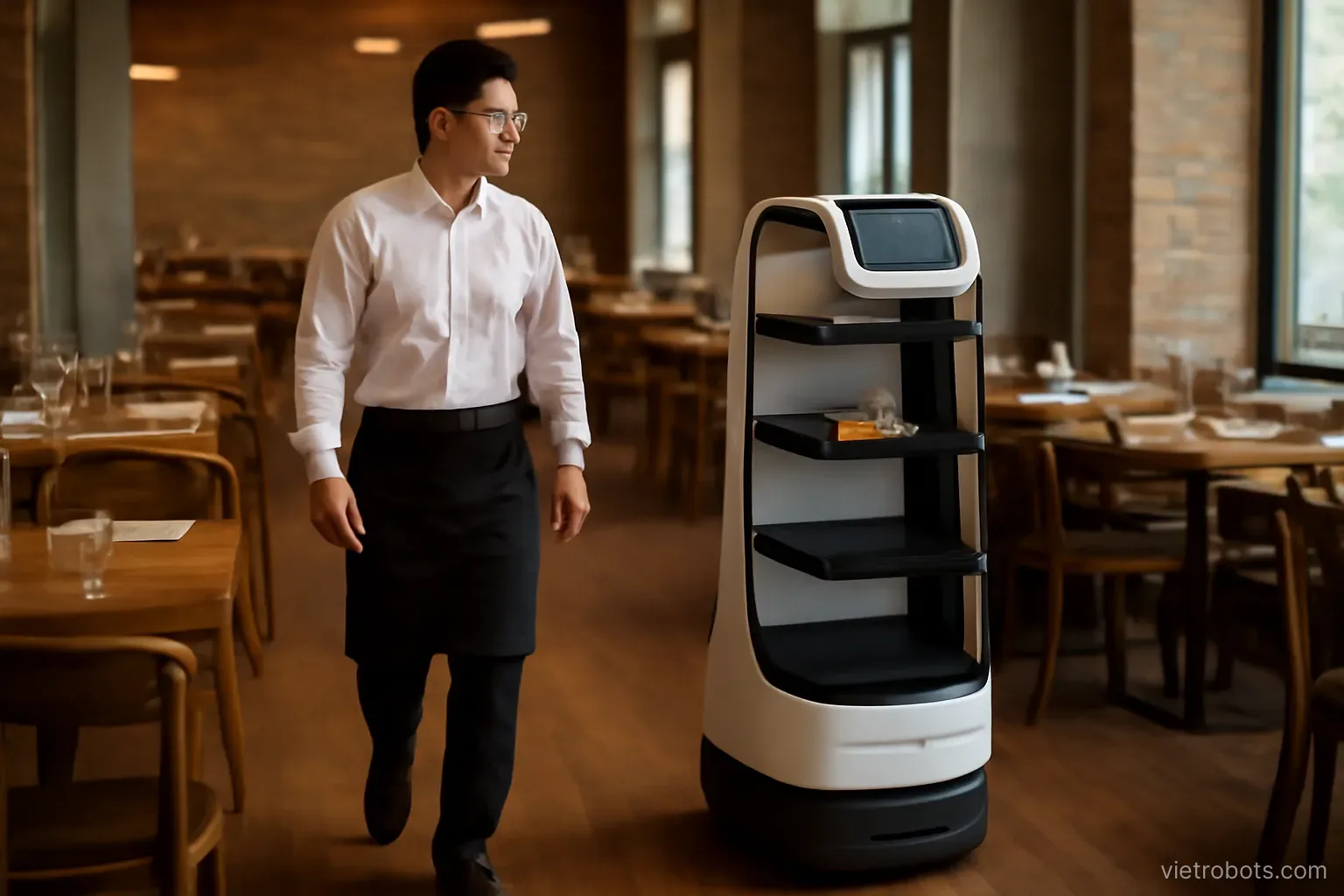
The question is usually put as whether robots will take jobs. That framing produces poor answers, because automation acts on tasks rather than on jobs, and almost every job is a bundle of very different tasks.
Tasks with high exposure
Answering the same question repeatedly. Opening hours, prices, directions, procedures. A well-loaded robot handles these accurately and indefinitely, and this is where most current deployments sit.
Moving things along fixed routes. Food from kitchen to table, linen between floors, samples between departments. Predictable paths in mapped buildings.
Cleaning open floor areas. Large, regular, uncluttered spaces.
Recording and transcribing. Turning speech into structured records.
Routine visual checking where the thing being checked is consistent and well lit.
Repeating a precise physical motion in a fixed setting with parts arriving in known positions.
The common feature: repetition, low variation, a stable environment, and a clear definition of correct. Where all four hold, automation is feasible. Where any is missing, it usually is not.
Tasks with low exposure
Handling unfamiliar physical objects. Still the hardest problem in robotics. Picking up something never encountered before, in an unknown position, is routine for a person and unsolved for a machine.
Working in cluttered, changing spaces. A kitchen mid-service, a building site, a home.
Reading a situation. Noticing that a customer is upset, that something is wrong before it can be articulated, that the usual approach will not work today.
Judgement with incomplete information. Deciding when the rules do not quite fit.
Persuading, negotiating, reassuring. Work that depends on the other person believing a human is engaged.
Non-routine physical work in awkward positions. Repair, installation, maintenance in confined or irregular spaces — heavily underestimated as automation-resistant.
The feature here is variability. Where every instance differs, the approach that works for repetitive tasks does not apply.
Assessing your own work
A practical method rather than a general answer.
List what you actually do across a normal week, in tasks rather than in job title terms. Most people are surprised by the range.
Estimate the time share of each.
Mark each against the four criteria. Repetitive, low variation, stable environment, clear definition of correct. Tasks scoring on all four are exposed.
Total the exposed share. This is the meaningful figure, and for most people it lands somewhere between ten and forty per cent rather than at nought or a hundred.
Consider what would happen if that share were absorbed. Usually the answer is that the remaining work expands, not that the role disappears.
Identify which of your low-exposure tasks you could do more of. This is the actionable part, and it is more useful than any prediction about the field as a whole.
What actually happens in workplaces
As distinct from what is projected.
Headcount usually does not fall. In most service deployments, the automated task was one that was hard to staff, absorbed time nobody valued, or simply was not being done well.
Work shifts rather than vanishes. Staff who no longer answer the same question forty times a day handle the more complex enquiries — which is more demanding and usually more valued.
New tasks appear. Someone must maintain content, handle faults, and manage the system. These are real jobs created by the deployment.
The composition of hiring changes. Over time a business may hire fewer people for the automated task and more for others — a gradual shift rather than a redundancy event.
Where jobs are lost, it is usually elsewhere. A business that automates and grows takes share from one that did not, and the effect appears at the second business. This is why workplace-level observation and economy-level statistics disagree.
What to do about it
Concrete, for an individual.
Increase the share of your work that involves judgement, people or unfamiliar situations. The single most useful move, and available in most roles.
Learn to work with these systems rather than around them. People who can use AI tools well are in a different position from those who cannot, and the gap is widening faster than the automation itself.
Do not compete on repetition. Any task you can describe as doing the same thing accurately many times is a poor place to build a position.
Build knowledge of a specific domain. General capability is what these systems have. Deep knowledge of a particular business, industry or place is what they lack.
Keep the physical skills that involve variation. Skilled trades requiring dexterity in irregular conditions are among the least exposed work there is, and they are undervalued in this conversation.
Do not panic and do not ignore it. The realistic timeline is gradual, which means there is time to adjust — but only for people who notice.
Frequently asked questions
Which tasks are actually exposed to automation?
Those that are repetitive, low in variation, in a stable environment, with a clear definition of correct — all four together. Answering the same question repeatedly, moving things along fixed routes, cleaning open floors.
What remains hard for robots?
Handling unfamiliar physical objects, working in cluttered changing spaces, reading a situation, judgement with incomplete information, and non-routine physical work in awkward positions.
Does headcount fall when a business deploys a robot?
Usually not. The automated task was typically hard to staff or absorbed time nobody valued. Work shifts to more complex enquiries and new tasks appear around maintaining the system.
What is the most useful individual response?
Increase the share of your work involving judgement, people or unfamiliar situations, and learn to use these systems well. Do not build a position on tasks that are simply repetition done accurately.
More in Robots in Vietnamese business and Cost and selection.